Supreme Court AI: Supreme Court Enters AI Era! Technology to Handle Case Allocation and Listing

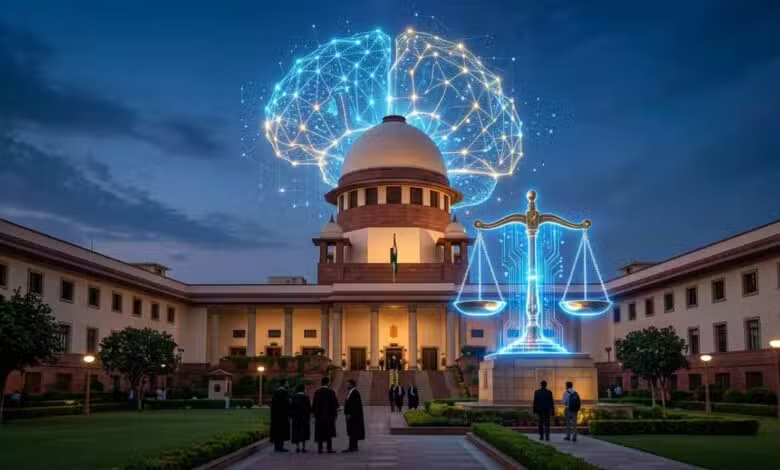
Supreme Court AI: The Supreme Court of India is stepping into a modern era by integrating Artificial Intelligence (AI) to handle crucial administrative tasks such as case listing and bench allocation. Guided by Chief Justice of India Surya Kant, this technological shift aims to streamline court operations, enhance transparency, and significantly minimize human involvement in the roster management system. Currently, the responsibility of assigning cases falls entirely on the Chief Justice, who acts as the “master of the roster.” By implementing AI tools, the apex court intends to make case distribution much more systematic, efficient, and error-free.
Drivers Behind the Technological Shift
The decision to introduce advanced technology follows a thorough internal review of the Supreme Court’s registry, which exposed several deep-rooted systemic inefficiencies. The inquiry brought two major issues to the forefront:
- Prolonged Incumbencies: Several officials had been occupying the same administrative posts for extended periods, leading to institutional stagnation.
- Outdated Infrastructure: The reliance on obsolete technological systems contributed to severe administrative lapses, including irregular and improper allocation of cases.
To combat these inefficiencies, the registry has already executed significant internal transfers, with another round of administrative reshuffling expected before the month concludes.
The Triggering Incident
The absolute urgency for reform was amplified during a recent hearing involving a challenge to the Uttar Pradesh Gangsters and Anti-Social Activities (Prevention) Act, 1986. The case was listed before a bench led by Chief Justice Surya Kant. However, during the proceedings, the Uttar Pradesh government pointed out a major flaw: a virtually identical plea had already been dismissed in December 2022 by a three-judge bench headed by former Chief Justice D. Y. Chandrachud.


Despite the previous dismissal, the matter mistakenly appeared on the cause list of an entirely new bench. This glaring anomaly provoked strong displeasure from the Chief Justice. He immediately ordered a comprehensive administrative investigation into the blunder and refused to let the petitioner simply withdraw the case, directing instead that it must reach a logical conclusion.
Vision for AI in Delivering Justice
To institutionalize these technological upgrades, the Supreme Court has formed a dedicated AI Committee. The Chief Justice has emphasized that artificial intelligence will be utilized positively and constructively to unlock its optimal potential. The ultimate goal is to eliminate systemic bottlenecks, thereby ensuring speedy, affordable, and accurate justice for all citizens without compromising on the human element where necessary.
Taking Cues from the Kerala High Court
In its journey toward digital modernization, the Supreme Court has drawn massive inspiration from the advanced Case Management System (CMS) developed internally by the Kerala High Court. Introduced in 2019, this CMS has transformed the Kerala High Court into a fully digital and paperless judicial institution.
This acclaimed model features automated workflows, 24/7 e-filing portals, and smart courtrooms equipped with “All-in-One” touchscreens that instantly display relevant digital case files to judges and advocates. Furthermore, the robust system incorporates AI-driven tools to assist with transcribing witness depositions and translating judicial orders under strict human supervision. The Supreme Court views this holistic, tech-forward approach as the perfect blueprint for modernizing India’s broader judicial framework and achieving a seamless legal ecosystem.
